

Chinvat Bridge
Mythological Narrative
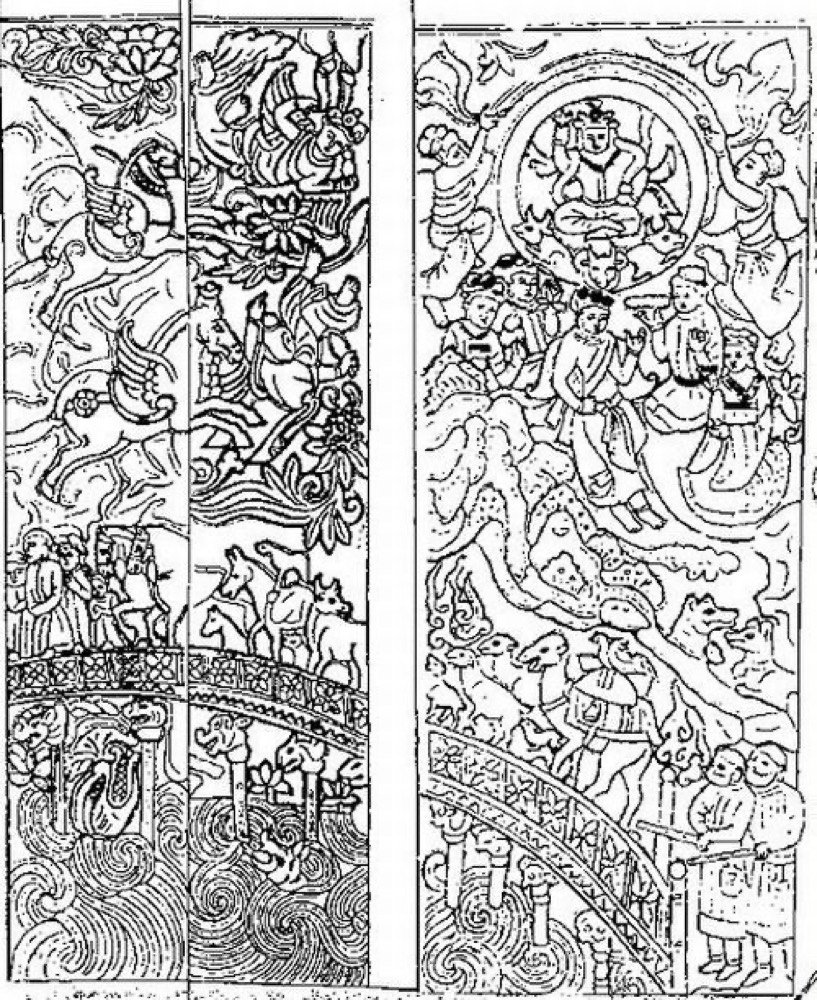
The Chinvat Bridge, Avestan for "bridge of the separator," is the hinge of the Zoroastrian afterlife. The prophet's own Gathas already invoke it: the righteous will be led across, while the followers of the Lie are denounced by their own souls at its head. As the Pahlavi books elaborate, the soul lingers near the body for three nights and comes to the bridge at the fourth dawn. The span runs from the Peak of Judgment, Chakad-i Daitik at the center of the world, to the Alborz range, over the gulf of hell; at its head sit Mithra, Sraosha, and Rashnu, the last holding golden scales that tip for no one, weighing every thought, word, and deed of the life just ended.
The judgment works through the bridge itself: for a soul whose good deeds prevail, the way broadens to nine spear-lengths, and a beautiful, fragrant maiden comes to meet him — his own daena, the embodiment of his faith and conduct — leading him up three steps into paradise. For the wicked the bridge turns on edge, thin as a razor, the daena appears as a hideous crone, and the soul plunges to a hell exactly as deep as its guilt. The ninth-century Pahlavi visionary text Arda Wiraz Namag recounts how the righteous Wiraz crossed the bridge in spirit under Sraosha's escort and toured the rewards and torments level by level, a book often set beside Dante's Divine Comedy. The image also passed into the later Islamic tradition of the Sirat bridge.
Academic Discussion & Critique
Exchange peer-reviewed hypotheses, comparative Indo-European etymologies, and archaeological field interpretations regarding Chinvat Bridge.
You Might Also Like
Ahura Mazda
Supreme god of Zoroastrianism, the "Wise Lord" who created the world and the order of asha, locked in a cosmic struggle with the destructive spirit Angra Mainyu.
Angra Mainyu
The destructive spirit opposed to Ahura Mazda, known in Middle Persian as Ahriman. He corrupts creation with vermin, disease, and death, and will be defeated at the world's renovation.
Mithra
The yazata of covenant and oath, thousand-eared and ten-thousand-eyed, who rides ahead of the sun and watches over all who break their word. His name later traveled to Rome.
Anahita
Goddess of rivers and fertility, "the moist, the strong, the immaculate." She pours from the divine mountain into the world sea; heroes and tyrants alike offered her sacrifice for victory.