

Humbaba
Mythological Narrative
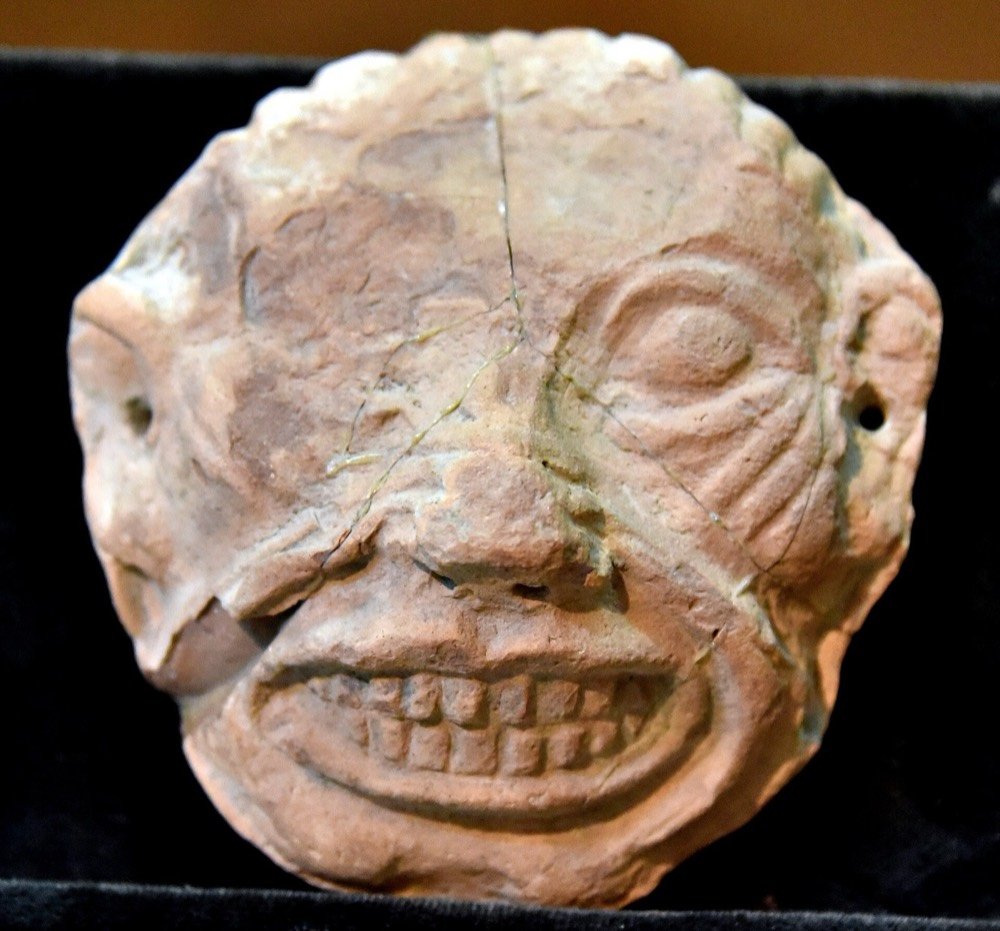
Humbaba — Huwawa in the older Babylonian and Sumerian texts — is the guardian whom Enlil set over the Cedar Forest to keep mortals from its timber. The epic gives him a terrifying kit: 'his voice is the Deluge, his speech is fire, his breath is death,' and no stirring in his forest at sixty leagues escapes his ears. His face became a thing in its own right: Old Babylonian clay masks render his features as a single coiled intestine, for diviners read entrails that curled 'like the face of Huwawa' as an omen; the British Museum keeps one such inscribed mask.
Tablets III to V of the Epic of Gilgamesh tell of his end. Gilgamesh and Enkidu march to the forest, and Shamash the sun god pins the guardian with thirteen winds. His seven auras of terror are his armor — in the Sumerian poem Gilgamesh and Huwawa he is coaxed into trading them away one by one for gifts, and discovers the trick only when the last is gone. On his knees he offers cedar and lifelong service; Gilgamesh wavers, but Enkidu presses him to strike before the gods learn of it. Dying, Humbaba curses them both. They carry his head to Enlil in a leather sack, and the god is furious; the deed weighs heavily when the gods later condemn Enkidu to death.
A tablet acquired by the Sulaymaniyah Museum in 2011 restored lost lines: the din of birds and monkeys in the cedar canopy, and the heroes' unease after felling the sacred trees.
Scholarly Commentary & Evolution
## Warden of the Cedar
Huwawa / Humbaba is Enlil's appointed guardian of the Cedar Forest. Gilgamesh and Enkidu cut him down anyway; the Standard Babylonian epic makes the killing a moral problem, not a clean trophy. His face is a coil of entrails in terracotta plaques.
The seven auras (melammu) are stripped one by one. The forest's protection dies with him.
## The Old Babylonian and Ishchali tablets
The earliest version, the Sumerian poem *Gilgamesh and Huwawa*, has Gilgamesh trick Huwawa into giving up his auras by offering gifts. In the Standard Babylonian epic (Tablet V) Shamash sends thirteen winds to pin Humbaba down, and Humbaba curses Enkidu before he dies; that curse is one thread leading to Enkidu's death. A tablet acquired in 2011 by the Sulaymaniyah Museum adds a vivid description of the forest as noisy with birds and monkeys, Humbaba's own court.
Academic Discussion & Critique
Exchange peer-reviewed hypotheses, comparative Indo-European etymologies, and archaeological field interpretations regarding Humbaba.
You Might Also Like
Enlil
'Lord Wind,' effective head of the Sumerian pantheon and keeper of the Tablet of Destinies, worshipped at Nippur. He split heaven from earth with a pickaxe — and sent the Flood because humans grew too noisy.
Gilgamesh
King of Uruk, two-thirds divine. With his friend Enkidu he slew Humbaba and the Bull of Heaven; after Enkidu's death he sought immortality in vain. His epic is among the oldest surviving works of literature.
Anzu
The lion-headed storm eagle who stole the Tablet of Destinies while Enlil bathed, until Ninurta shot it down by stratagem; in other poems the great bird repays kindness with gifts.
Lamassu
Human-headed, eagle-winged bull colossi with horned crowns, some carved with five legs, that stood in pairs at the palace gates of Nimrud, Khorsabad, and Nineveh to turn evil away.