

Enlil
Also known as: Ellil, Nunamnir
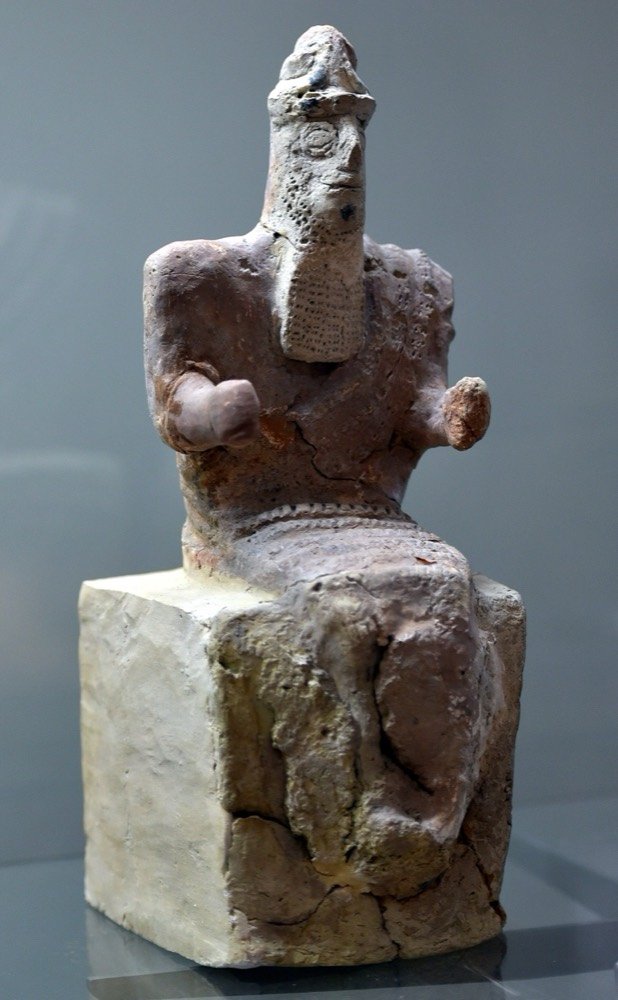
Mythological Narrative
Enlil, 'Lord Wind,' god of air and earth, was the effective head of the Sumerian pantheon. The sky god An outranked him in theory, but it was Enlil who issued decrees and held the Tablet of Destinies; Mesopotamian texts use 'Enlilship' as a byword for supreme divine authority. His holy city was Nippur, his temple the Ekur, 'Mountain House.' Nippur never ruled an empire, yet it was the religious center of Sumer, and kings who claimed lordship over the land sought Enlil's sanction there.
The Sumerian Song of the Hoe has him split the junction of heaven and earth with his pickaxe so that humans could sprout from the soil. In Enlil and Ninlil he forces himself on the young goddess Ninlil by the canal at Nippur and is banished to the netherworld by the assembly of the gods; Ninlil follows him, pregnant with the moon god Nanna, and along the way conceives three infernal deities. His majesty always carried a destructive edge: in the Atrahasis epic the din of multiplying humanity robs him of sleep, and after plague, drought, and famine fail he unleashes the Flood, settling afterward with Enki on infant mortality and barrenness as permanent checks on human numbers.
From the later second millennium BCE his rank passed to Marduk of Babylon and to Ashur, the Assyrian state god — Assyrian copies of Enuma Elish simply substitute Ashur as hero. The Ekur precinct at Nippur, dug repeatedly since the 1890s by the University of Pennsylvania and others, has yielded tens of thousands of tablets, the single richest source of Sumerian literature.
Scholarly Commentary & Evolution
## Lord Wind and Storm
Enlil is the most powerful of the active gods, second only to Anu in the cosmic hierarchy but first in practical authority. His name means 'Lord Wind' or 'Lord of the Command,' and he embodies both the life-giving breeze and the destructive storm. Where Anu reigns in distant majesty, Enlil governs the cosmos with an iron will.
### The Holder of Destinies
Enlil possesses the Tablet of Destinies, the divine object that grants supreme authority over the cosmos. With this tablet, he decrees the fates of gods, cities, and mortals. His word is irrevocable law. When he speaks, the other gods bow their heads in submission.
### The Great Flood
Enlil's most famous act was decreeing the Great Flood to destroy humanity, whose noise disturbed his sleep. Only through Enki's cunning intervention was Utnapishtim warned and able to build an ark, preserving human life. This myth reveals Enlil's harsh, sometimes capricious nature alongside his supreme power.
### The King-Maker
All earthly kings derived their authority from Enlil. His temple at Nippur, the Ekur ('Mountain House'), was the spiritual center of Sumer, and no king's reign was legitimate without his blessing. Enlil did not merely sanction kings; he actively raised them up and cast them down according to his divine will.
### Legacy
Enlil's role as storm god and father of gods strongly influenced later concepts of supreme deities in the Near East, including aspects of the Hebrew God YHWH, particularly the image of the divine storm and irrevocable decree.
Cross-Pantheon Parallels & Archetypes
Academic Discussion & Critique
Exchange peer-reviewed hypotheses, comparative Indo-European etymologies, and archaeological field interpretations regarding Enlil.
You Might Also Like
Anzu
The lion-headed storm eagle who stole the Tablet of Destinies while Enlil bathed, until Ninurta shot it down by stratagem; in other poems the great bird repays kindness with gifts.
Tablet of Destinies
A sealed clay tablet conferring supreme command: whoever wears it decrees fate. Anzu stole it from bathing Enlil; Tiamat pinned it on Qingu; Marduk finally sealed it as his own.
Enki
God of wisdom, fresh water, and crafts, Akkadian Ea, dwelling in the Abzu at Eridu. He proposed the creation of humankind and leaked the secret of the coming Flood through a reed wall.
Humbaba
Guardian of the Cedar Forest appointed by Enlil, his face a coil of entrails, his roar the Deluge. Gilgamesh and Enkidu tricked him out of his seven auras and killed him despite his pleas.