

Sugisawa Village
Mythological Narrative
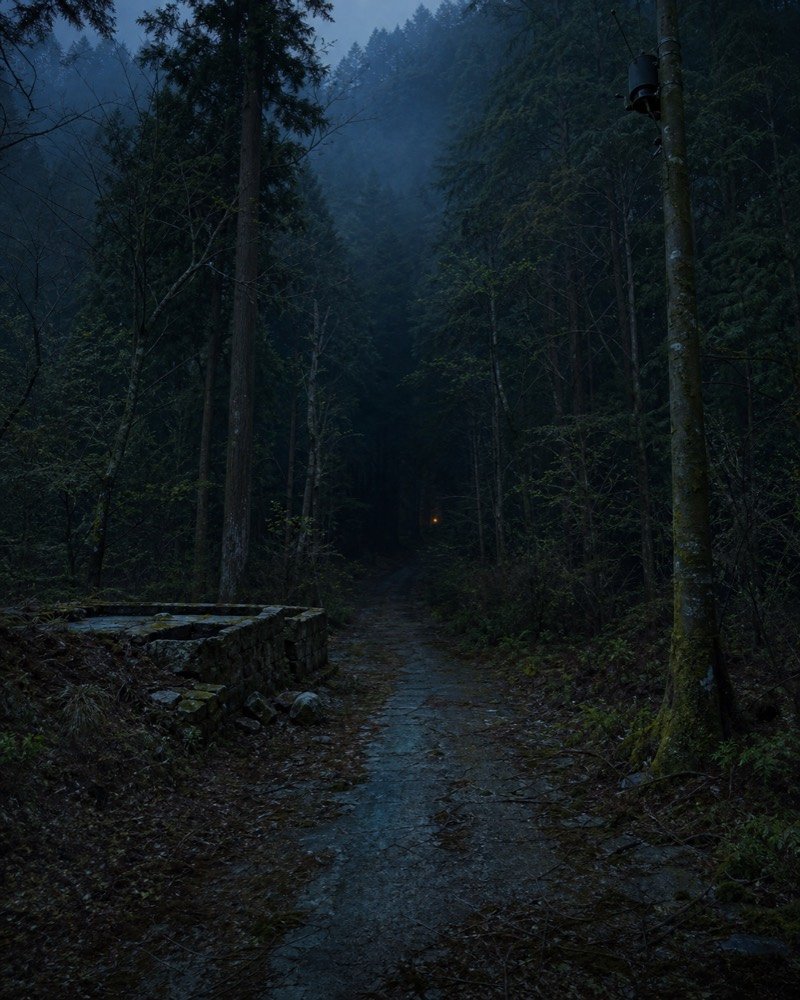
The Sugisawa legend arrives fully furnished. In the early Showa years, in a small mountain village of Aomori prefecture called Sugisawa, one villager went suddenly mad, killed every other inhabitant in a night, and took his own life. The village lay abandoned, was administratively merged into a neighbor, and its name was struck from maps, land registers, and public documents. The entrance is said to survive: a rock shaped like a skull beside a wooden sign reading, 'Those who go beyond this point forfeit their lives.' Explorers who find the village disappear; one account has a party seeing heaps of bones in a ruined house, the survivors losing their minds.
The story circulated on personal websites and BBS boards in the late 1990s, and in August 2000 Fuji TV's variety program Unbelievable aired a feature on 'the village not on the map.' Aomori's prefectural offices fielded waves of inquiries, legend-trippers poured into the hills, and Sugisawa became a national byword. Hamlets outside Aomori city are regularly proposed as the original, but the prefecture has stated plainly that no record of such a massacre exists, and the gap between tale and record became part of the tale.
Sugisawa is the northern mirror of the Inunaki type of hidden-village legend, sharing its grammar: a name erased by officialdom, a signposted threshold, visitors who do not come back. It is also read as a forerunner of the 'otherworld expedition' genre of 2channel-era horror, in which the most durable monster is a place that maps refuse to show.
Academic Discussion & Critique
Exchange peer-reviewed hypotheses, comparative Indo-European etymologies, and archaeological field interpretations regarding Sugisawa Village.
You Might Also Like
Inunaki Village
Beyond the old tunnel at Inunaki Pass in Fukuoka, legend places a village on no map, its entrance signed 'The constitution of Japan does not apply beyond this point.' The story spread online from the late 1990s.
Kisaragi Station
Late on 8 January 2004, a 2channel user posting as Hasumi live-reported that her train from Shin-Hamamatsu had passed every stop and left her at a deserted station called Kisaragi. Her posts ended after she accepted a stranger's ride.
Aka Manto
A voice in the toilet stall asks, 'Red cloak or blue cloak?' Red brings death drenched in blood, blue death drained of it. The earliest documented outbreak was the Aka Manto panic among Tokyo schoolchildren in February 1939.
The Peony Lantern
Night after night the ronin Shinzaburo meets his lover Otsuyu, who arrives with a peony lantern, geta clacking. A neighbor peers in and sees a skeleton in his arms. The most romantic of Edo's great ghost tales.