

Ame-no-Uzume
Also known as: Ame-no-Uzume-no-Mikoto, Uzume, Okame
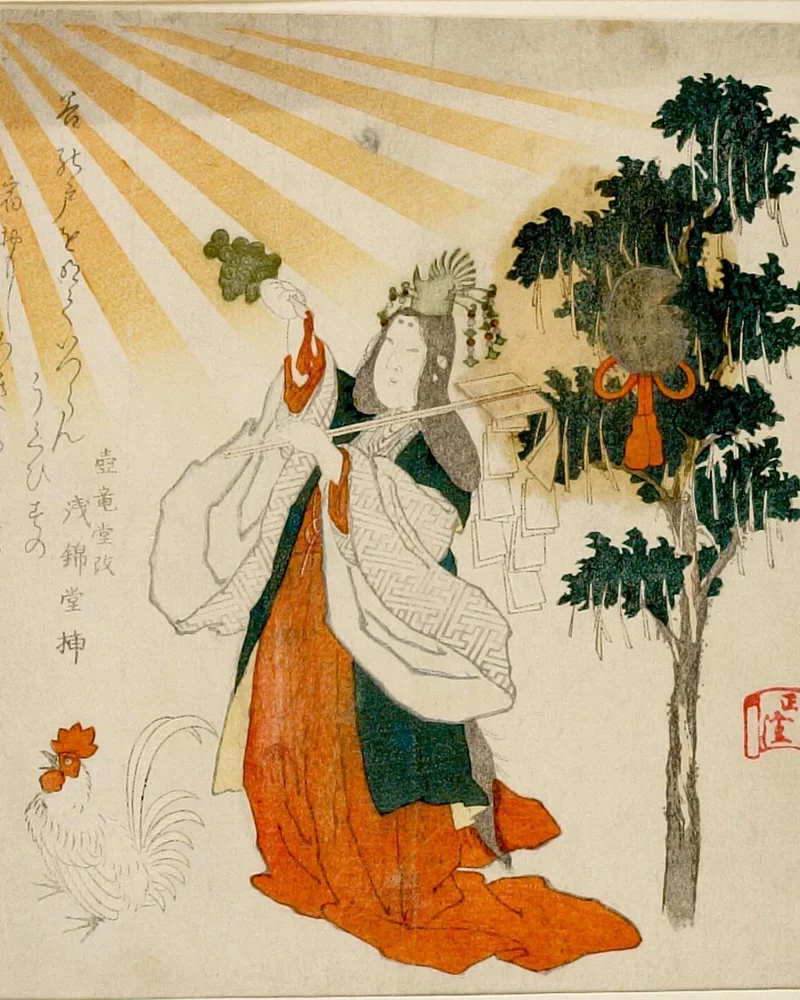
Mythological Narrative
Goddess of dawn, mirth, and revelry. Her wild, comedic dance lured Amaterasu from the Heavenly Rock Cave, restoring light to the world. Ancestral deity of performing arts.
Scholarly Commentary & Evolution
## The Goddess Who Restored the Sun
**Ame-no-Uzume-no-Mikoto** holds one of the most pivotal roles in Japanese mythology. When Amaterasu withdrew into the Heavenly Rock Cave and darkness engulfed the world, it was Ame-no-Uzume's bold, outrageous performance that ultimately saved creation by drawing the sun goddess back into the light.
### The Sacred Dance
According to the **Kojiki** and **Nihon Shoki**, when all other attempts to coax Amaterasu from her cave failed, Ame-no-Uzume took action. She overturned a wooden tub before the cave entrance, mounted it as a stage, and began to dance. Her movements grew increasingly wild and ecstatic. She partially disrobed, exposing herself in a way that caused the assembled kami to burst into thunderous laughter. The sound puzzled Amaterasu—how could there be merriment when the world was in darkness? Her curiosity overcame her grief, and she peeked out to see what caused such joy. At that moment, the strong-armed god **Ame-no-Tajikarao** pulled her fully out, and light returned to the world.
### The Entertainer's Ancestor
Ame-no-Uzume is considered the divine ancestor of the **Sarume** clan, traditional shrine performers, and by extension all performing artists in Japan. Her dance before the cave is regarded as the first theatrical performance—a sacred act that saved the world through the power of entertainment. This connects her to the origins of **kagura** (Shinto theatrical dance) and influenced the development of Noh and other traditional performing arts.
### Confronting Sarutahiko
When the gods sent Ninigi (Amaterasu's grandson) to rule the earth, they encountered **Sarutahiko-Okami**, a fearsome earthly kami blocking the path. While the other heavenly deities hesitated, Ame-no-Uzume boldly approached him. Some accounts say she bared herself again; others describe her simply showing fearless confidence. She convinced Sarutahiko to guide Ninigi's descent. Ame-no-Uzume and Sarutahiko later married, linking the heavenly and earthly realms.
### The Okame Mask
Ame-no-Uzume's face is the basis for the **Okame** (or Otafuku) mask—the round, cheerful, smiling female face seen throughout Japanese folk art and at festivals. This mask represents good fortune, mirth, and fertility. Her image reminds worshippers that joy, laughter, and bold action can overcome even the darkest circumstances.
Cross-Pantheon Parallels & Archetypes
Academic Discussion & Critique
Exchange peer-reviewed hypotheses, comparative Indo-European etymologies, and archaeological field interpretations regarding Ame-no-Uzume.
You Might Also Like
Eos
The goddess of dawn, sister of Helios and Selene, who rises each morning from the bed of her mortal consort Tithonus to bring light to gods and men. Homer's formula 'rosy-fingered Dawn' marks the start of countless days in the Iliad and Odyssey.
Usha
The Vedic goddess of dawn, praised in some twenty hymns of the Rigveda as a radiant young woman who drives away darkness, wakes every living creature, and returns each morning ever young while the generations of mortals pass away.
Amaterasu
The sun goddess who rules Takamagahara and heads the imperial mythic lineage; her retreat into the Heavenly Rock Cave plunged heaven and earth into darkness.
Benzaiten
Goddess of everything that flows: water, time, words, music, and knowledge. One of the Seven Lucky Gods. Originated from Hindu goddess Saraswati.