

Mount Yanzi
Mythological Narrative
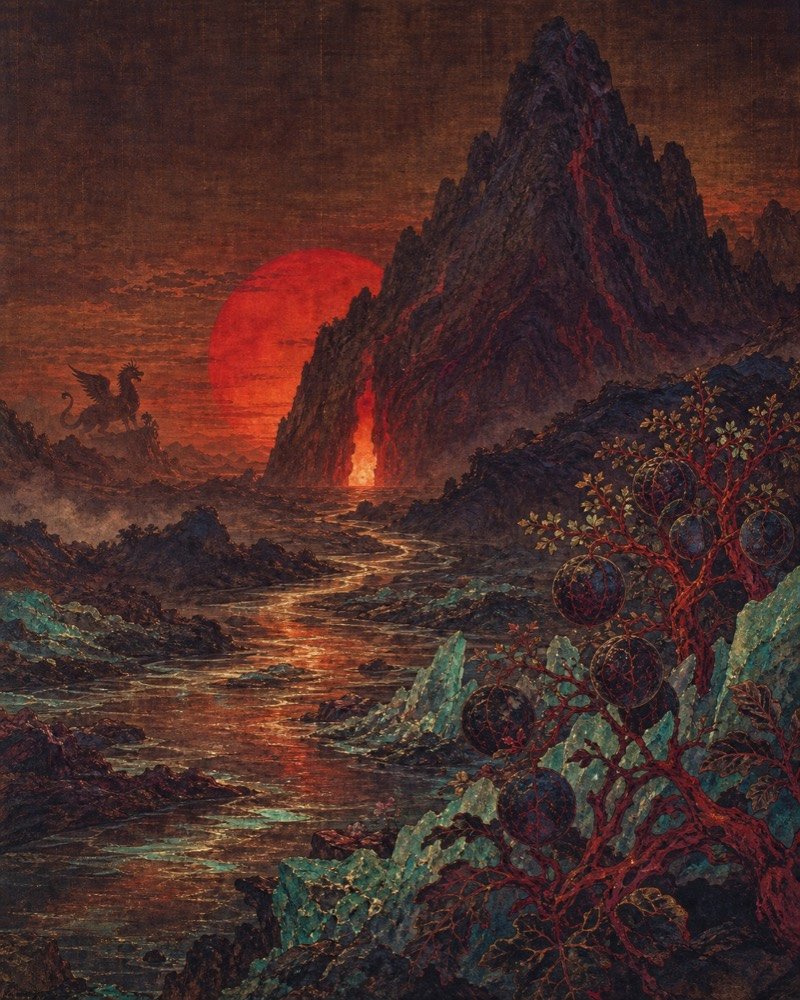
Mount Yanzi closes the fourth guideway of the western mountains. On it grow cinnabar trees 'with leaves like the paper mulberry and fruit the size of melons, red-rinded and black-veined', a fruit that cures jaundice and guards against fire; turtles abound on its southern slopes and jade on its northern; the River Tiao rises here and flows west to the sea over beds of whetstone.
Its beast and bird are both prodigies. The Shuhu has 'a horse's body with bird's wings, a human face and a snake's tail', and delights in picking people up and holding them aloft; the bird is owl-shaped with a human face, monkey-bodied and dog-tailed, calls its own name, and brings great drought to any town where it appears.
What made Yanzi immortal was Qu Yuan. In the Lisao the poet commands Xihe, charioteer of the sun, to slacken pace — 'gazing at Yanzi, do not press near' — for, as Wang Yi's commentary explains, Yanzi is the mountain into which the sun sets. Ever since, the name has meant sunset itself in literary Chinese, and 'the sun nearing Yanzi' still describes old age and closing days. Traditional geographers placed the mountain southwest of Tianshui in Gansu.
Academic Discussion & Critique
Exchange peer-reviewed hypotheses, comparative Indo-European etymologies, and archaeological field interpretations regarding Mount Yanzi.
You Might Also Like
Feiyi
A serpent of Mount Taihua with six legs and four wings whose appearance brings drought to the whole world; Guo Pu records that it was seen at Mount Yang in the days of King Tang.
Land of the Long-Armed
A country whose people wade into the water and catch fish bare-handed, one in each fist. Old glosses say their arms are so long the hands trail on the ground.
Land of the Giants
A country of huge people in the eastern seas, glimpsed sitting at work in their boats; another chapter records a giants' market out on the open sea.
Land of the Di People
A country west of the sky-ladder tree Jianmu whose people have human faces and fish bodies without feet. Commentators identify them with the heaven-climbing Hu people, descendants of the Flame Emperor.