

Qinyuan
Mythological Narrative
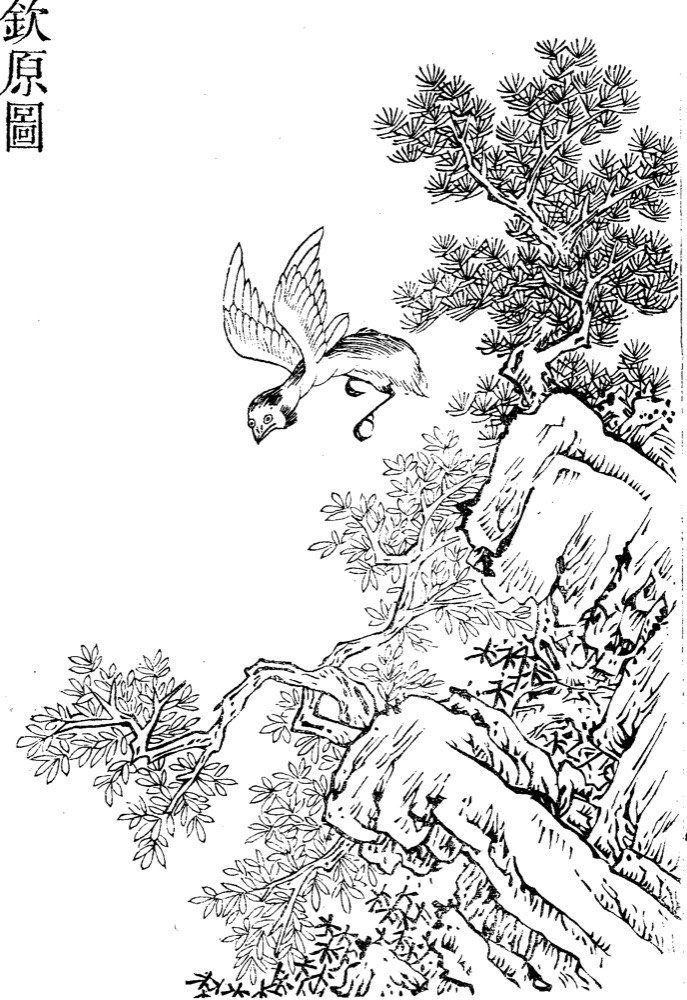
The Mound of Kunlun is 'the lower capital of the High God', warded on the ground by nine-tailed Luwu; its air belongs to a single venomous bird. 'There is a bird there,' says the 'Classic of the Western Mountains', 'shaped like a wasp and as large as a mandarin duck, named Qinyuan; birds and beasts that it stings die, and trees that it stings wither.'
On the same mountain the classic lists the man-eating four-horned ram Tulou, the shatang fruit that keeps its eater from drowning, and the pin herb that banishes weariness — Kunlun's produce splits neatly into gifts and killers. Venomous creatures are rare in the Shanhaijing, and none is credited with venom more absolute than the Qinyuan's, which kills outright and withers living wood. Ming and Qing illustrated editions draw it as a giant wasp trailing its sting above the terraces of Kunlun.
Academic Discussion & Critique
Exchange peer-reviewed hypotheses, comparative Indo-European etymologies, and archaeological field interpretations regarding Qinyuan.
You Might Also Like
Tulou
A man-eating beast of the Mound of Kunlun, shaped like a ram with four horns, sharing the High God's lower capital with the warden Luwu and the venomous Qinyuan.
Luwu
Tutelary god of the Mound of Kunlun: tiger-bodied with nine tails, a human face and tiger claws, keeper of heaven's nine regions and the seasons of the God's park.
Mount Kunlun
The great mythic mountain of the far west, the High God's capital on earth and home of the Queen Mother of the West; to climb its successive terraces was to gain deathlessness and reach heaven.
Kaiming Beast
Guardian of Kunlun's nine gates: a body like a giant tiger crowned with nine human-faced heads, standing atop the mountain facing east, warding the abode of the hundred gods.