

Sarayashiki (Okiku)
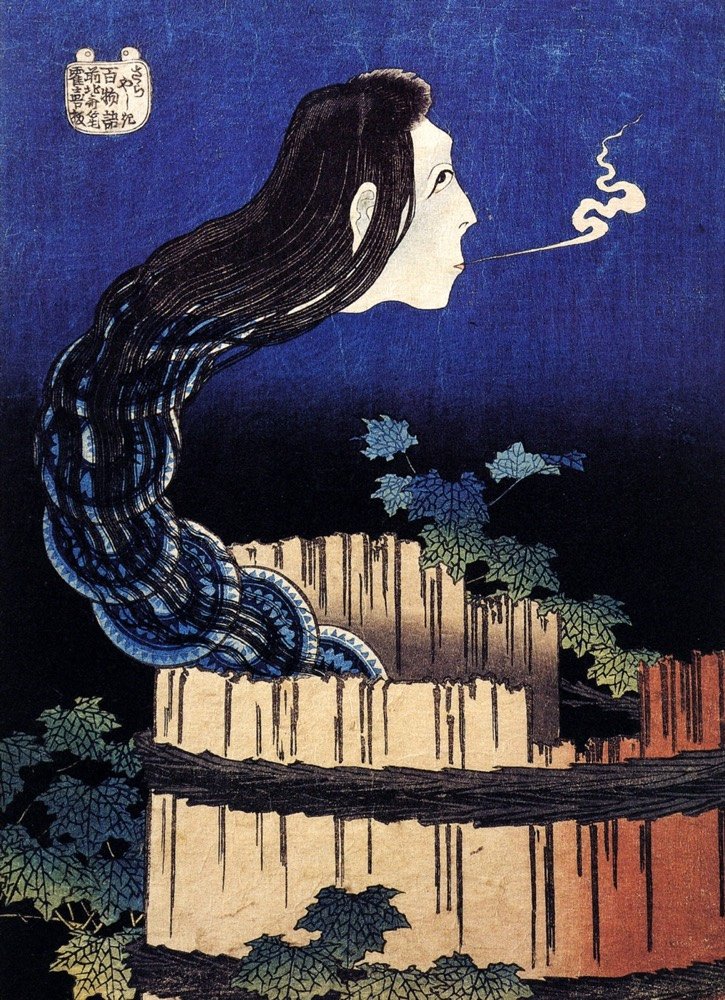
Mythological Narrative
The skeleton of the tale is simple. The maidservant Okiku has charge of a set of ten heirloom plates; one is broken or hidden to frame her, her master tortures and kills her on that pretext, and her body goes down the estate well. Every night thereafter a woman's voice counts from the bottom of the well, one plate, two plates, three, and at nine it collapses into weeping and begins again, never reaching ten.
Dozens of places in Japan claim a Sarayashiki, a 'dish mansion,' but two lineages dominate. In the Banshu line, set in Himeji, Okiku is a loyal servant who has discovered the steward Aoyama Tetsuzan's plot against his lord; he hides one plate of an heirloom set to convict her, has her beaten, and throws her into the well. A well in the grounds of Himeji Castle is still shown as Okiku's Well. In the Edo line the master is the hatamoto Aoyama Shuzen of Bancho. The puppet play Banshu Sarayashiki premiered at the Toyotake-za in Osaka in 1741; in 1916 Okamoto Kido's new-kabuki Bancho Sarayashiki rewrote it as a tragedy of trust, in which Okiku deliberately breaks a plate to test her lover's heart and he kills her for doubting him.
In 1795 a mass emergence of swallowtail pupae around Himeji, each resembling a tiny woman with bound arms, was talked of across the country as 'Okiku bugs,' her grudge made flesh.
Academic Discussion & Critique
Exchange peer-reviewed hypotheses, comparative Indo-European etymologies, and archaeological field interpretations regarding Sarayashiki (Okiku).
You Might Also Like
Yotsuya Kaidan (Oiwa)
The ronin Iemon poisons his wife Oiwa; her face hideously disfigured, she dies cursing him and returns as a vengeful ghost. Tsuruya Nanboku's 1825 kabuki play made her the archetype of the Japanese onryo.
The Peony Lantern
Night after night the ronin Shinzaburo meets his lover Otsuyu, who arrives with a peony lantern, geta clacking. A neighbor peers in and sees a skeleton in his arms. The most romantic of Edo's great ghost tales.
Hanako-san of the Toilet
Knock three times on the third stall of the third-floor school toilet and ask, 'Hanako-san, are you there?' A small voice answers, 'I'm here.' The best-known figure of Japanese school ghost lore, a nationwide craze by the 1980s.
Kasane-ga-fuchi
Kasane, a farm wife of Hanyu village, is drowned by her husband in the Kinugawa river; her ghost possesses a later daughter until the priest Yuten uncovers an identical murder a generation earlier.