

Mama Killa
Also known as: Mama Quilla
Mythological Narrative
Mama Killa, Mother Moon, was sister and wife to the sun god Inti; in the royal genealogy the dynasty's founders Manco Cápac and Mama Ocllo were reckoned children of the sun and moon. Silver was her metal. Within the Coricancha a chamber was set aside for her, its walls sheathed in silver plate around an image of the moon with a woman's face, and the preserved bodies of dead queens kept watch on either side. Her earthly counterpart was the Coya, the Inca queen, who led the moon's rites as the king led the sun's.
She watched over the lives of women — marriage, weaving and childbirth all fell under her care — and the ritual calendar ran by her phases, each month reckoned from the new moon. Coya Raymi in September was her festival and the queen's, the month of the Situa rites that purified Cusco.
An eclipse had its own reading: a great serpent or a puma had sprung upon the moon to devour her, and if it succeeded she would fall to earth and the world go dark. So on eclipse nights the city erupted — pots beaten, trumpets blown, dogs whipped into howling — until the shadow withdrew. Cobo sets down the details in his Historia del Nuevo Mundo. Beyond Cusco her greatest sanctuary was the Island of the Moon in Lake Titicaca, where the stone walls of the Iñak Uyu house of chosen women still stand.
Scholarly Commentary & Evolution
## Wife of the Sun
Garcilaso de la Vega calls the Moon *Mama Quilla*, 'Mother Moon', and describes her as the sister and wife of the Sun and the mother of the Incas. In the Coricancha her chamber was lined with silver and held a silver image with a woman's face, and the bodies of dead queens (*coyas*) were set there, much as the kings' bodies sat before the Sun. The pairing mirrors the royal marriage of the Inca ruler to his sister-queen, and the queen was the Moon's earthly counterpart.
## Months and eclipses
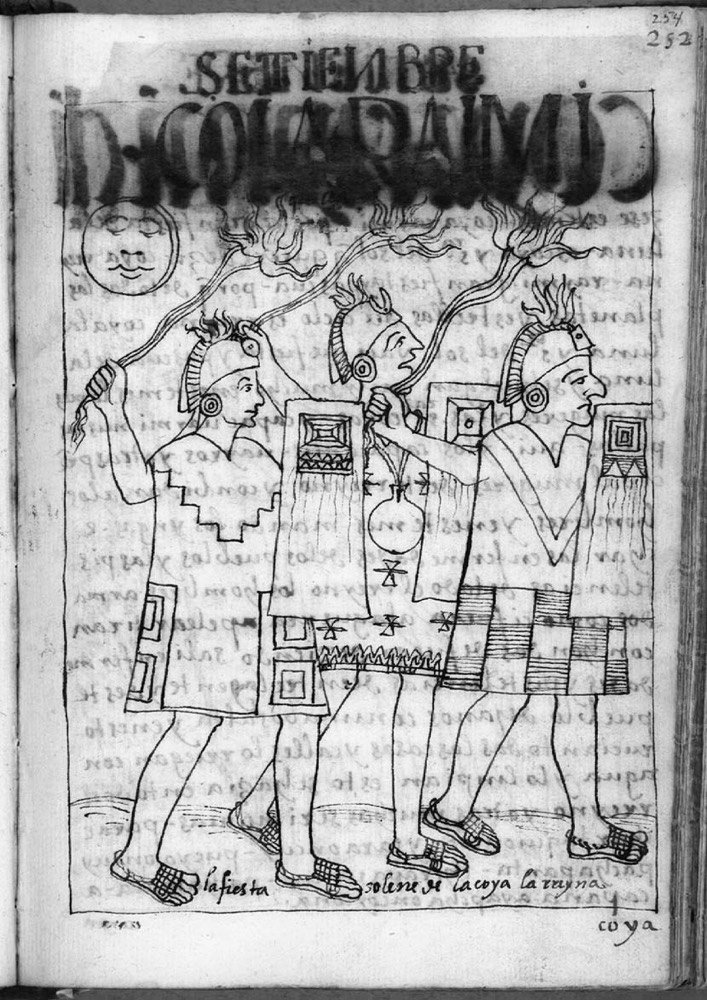
The Inca calendar combined solar observations with lunar months (*killa* means both 'moon' and 'month'), and many festivals were timed by the moon. Guaman Poma's calendar names the September month *Coya Raymi*, the feast of the queen, the season of the Citua purification ceremonies that Molina describes. Garcilaso reports that during a lunar eclipse people believed the Moon was falling sick and might die, and shouted, blew horns, and beat dogs to make them howl so that she would wake.
## Evidence
Mama Killa is attested almost entirely through descriptions of the Cusco state cult; no extended myth about her survives comparable to those of Viracocha or the Huarochirí huacas.
Academic Discussion & Critique
Exchange peer-reviewed hypotheses, comparative Indo-European etymologies, and archaeological field interpretations regarding Mama Killa.
You Might Also Like
Inti
Sun god and royal ancestor of the Inca empire, pictured as a golden disk with a human face. The Sapa Inca ruled as his son; Coricancha and the June solstice feast were his.
Coricancha
Holiest sun temple of the Inca empire, its walls sheeted in gold, its garden set with golden maize and llamas. The priory of Santo Domingo was built on its walls, which have outlasted two great earthquakes.
Manco Cápac
Legendary first Inca king. In one tale he and Mama Ocllo rose from Lake Titicaca at the Sun's command, seeking where a golden rod would sink; in another he was among eight siblings who left the cave at Pacaritambo.
The Creation at Lake Titicaca
The world lay in darkness until Viracocha appeared at Lake Titicaca and called the sun up from the sacred rock on the Island of the Sun; moon and stars followed, and the nations were summoned from caves and springs.