

Osiris
Also known as: Usir, Lord of the Perfect Black
Mythological Narrative
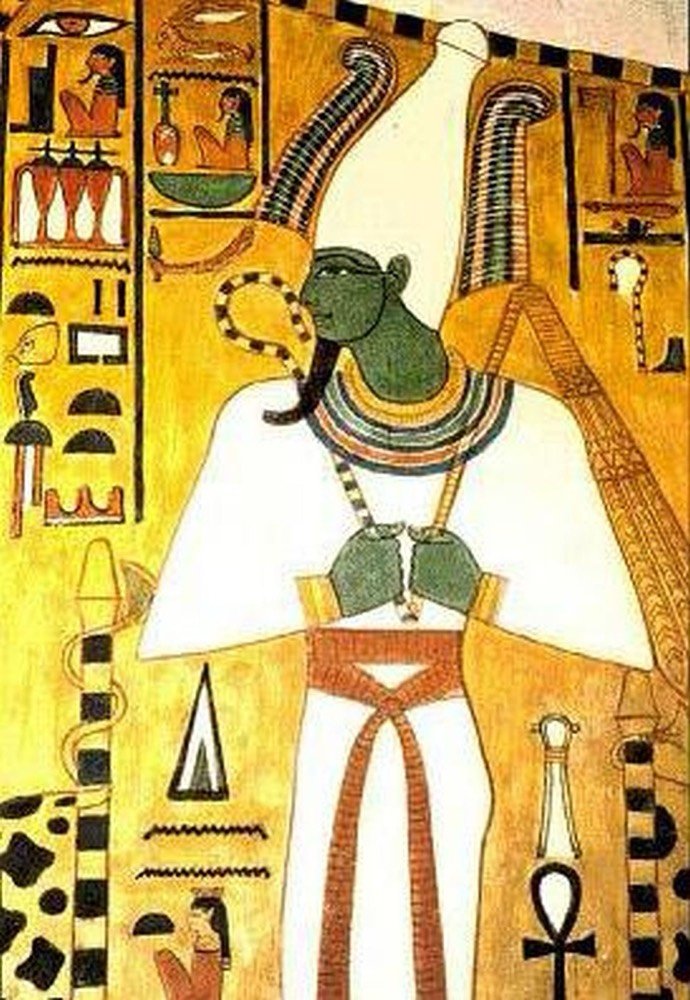
Osiris appears as an upright mummy: body wrapped in white linen, hands crossed over the chest holding the crook and flail of kingship, head bearing the atef crown, a white miter flanked by two ostrich feathers. His skin is painted green or black, the colors of sprouting vegetation and of the fertile silt left by the Nile flood. He is at once lord of the dead, god of resurrection, and god of agricultural abundance, the river's annual rise and fall being read as the rhythm of his death and revival.
His myth was Egypt's most widely told story. Osiris ruled on earth as a good king until his jealous brother Set tricked him at a banquet into lying inside a splendid chest built to his measure, nailed it shut, and threw it into the Nile. After Isis recovered the body, Set dismembered it, in Plutarch's account into fourteen pieces scattered across Egypt. Isis and her sister Nephthys gathered the parts, Anubis bound them into the first mummy, and Isis, hovering as a kite, fanned breath back into her husband and conceived their son Horus. The revived Osiris thereafter remained in the Duat, presiding over the judgment of the dead in the Hall of Two Truths.
Abydos was his great sanctuary, where annual mystery plays reenacted his passion from the Middle Kingdom onward. From the Pyramid Texts on, the dead king was identified with Osiris; by the New Kingdom every properly buried person was called 'the Osiris so-and-so.'
Scholarly Commentary & Evolution
## Lord of the Dead
Osiris was the first mythical pharaoh of Egypt, who brought civilization and agriculture. After being murdered and dismembered by his jealous brother Set, he was resurrected by Isis to rule the Underworld.
### Judgement of the Dead
As ruler of the afterlife, Osiris presides over the weighing of the heart. He represents hope for eternal life and the cycle of vegetation and regeneration.
Cross-Pantheon Parallels & Archetypes
Classical Art & Museum Artifacts
High-resolution museum artifacts, classical sculptures, pottery reliefs, and bronze idols preserving authentic historical representations of Osiris.
Statuette of Osiris

Bronze statuette of Osiris
Academic Discussion & Critique
Exchange peer-reviewed hypotheses, comparative Indo-European etymologies, and archaeological field interpretations regarding Osiris.
You Might Also Like
Anubis
The black jackal-headed god of embalming who made the first mummy for Osiris; he guards cemeteries, guides the dead, and steadies the scales at the judgment of the heart.
Duat
The netherworld the sun crosses each night, divided into twelve hour-regions with rivers, lakes of fire, and guarded gates; here the dead are judged, the justified passing on to the Field of Reeds.
Weighing of the Heart
The dead stand trial in the Hall of Two Truths: the heart is balanced against Maat's feather while Thoth records and the monster Ammit waits — a heavy heart is devoured on the spot.
Horus
The falcon sky god whose eyes are the sun and moon. Posthumous son of Osiris, he contested the throne with Set for eighty years and won; every living pharaoh was his incarnation.