

Headless Horseman
Mythological Narrative
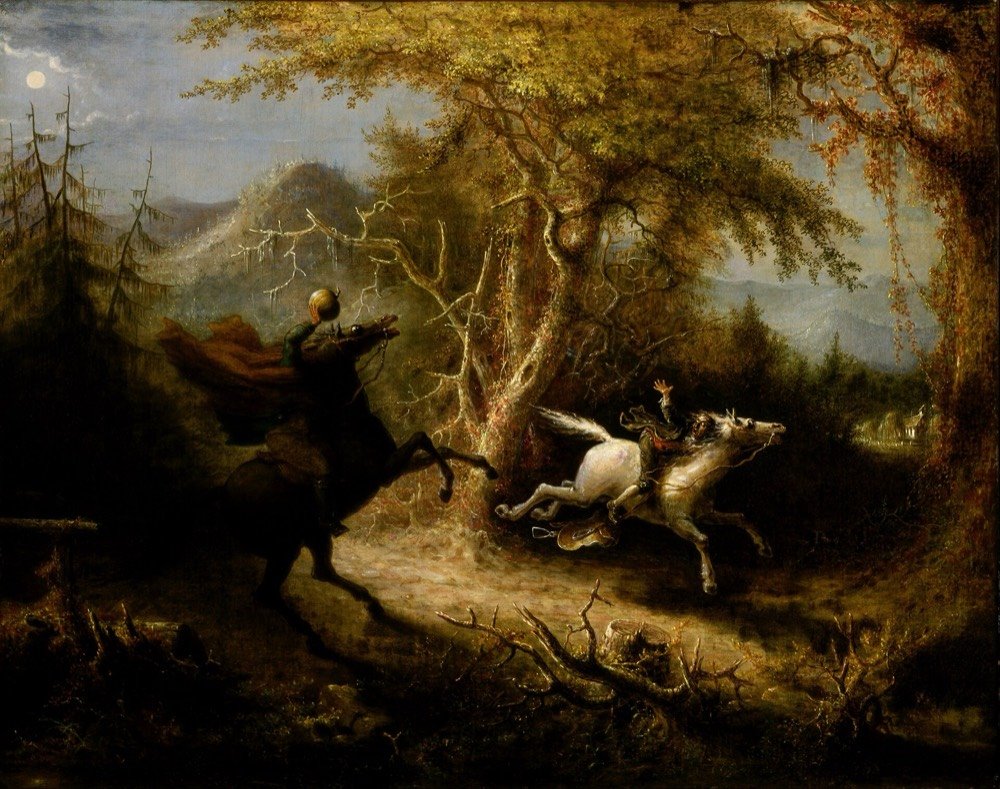
The Headless Horseman haunts Sleepy Hollow, a Dutch settler community near Tarrytown on the Hudson: a Hessian mercenary fighting for the British in the Revolutionary War, decapitated by a cannonball in a nameless skirmish and buried in the Old Dutch Church graveyard. Night after night he rides out searching for his head, galloping hard because he must regain his grave before cockcrow; cross the wooden bridge by the church, the story says, and he cannot follow.
The figure comes from Washington Irving's "The Legend of Sleepy Hollow," published in The Sketch Book in 1820 and among the first classics of American fiction. In the tale, Ichabod Crane, a lanky, superstitious Connecticut schoolmaster, courts the heiress Katrina Van Tassel while his rival Brom Bones torments him; riding home from a party, Crane is chased to the church bridge, where the rider's "head" strikes him full in the face. The next morning the road yields only his hat and a shattered pumpkin, and the schoolmaster is never seen again. Irving leaves the verdict open: a true ghost, or Brom with a pumpkin. He drew on the oral lore of the Hudson Valley Dutch and on the European headless-rider lineage — Ireland's dullahan and the German tales collected by Karl Musaus.
The Horseman rode off the page into America's Halloween iconography, most famously via Disney's The Adventures of Ichabod and Mr. Toad (1949) and Tim Burton's Sleepy Hollow (1999). The village of North Tarrytown formally renamed itself Sleepy Hollow in 1996, and Irving's Old Dutch Church and its burying ground still stand, thronged with visitors every October.
Academic Discussion & Critique
Exchange peer-reviewed hypotheses, comparative Indo-European etymologies, and archaeological field interpretations regarding Headless Horseman.
You Might Also Like
Bell Witch
"Kate," an invisible entity said to torment the Bell family of Adams, Tennessee from 1817 to 1821 — knocking, slapping young Betsy, speaking and singing aloud; legend holds it poisoned patriarch John Bell.
La Llorona
A woman in white who drowned her own children and now wanders riverbanks at night crying "Ay, mis hijos!" — a legend of Mexico and the U.S. Southwest used to warn children away from water after dark.
Black-Eyed Children
An internet legend seeded by Texas reporter Brian Bethel's 1996 mailing-list account: children who knock on doors or car windows at night asking for help, their eyes solid black, insisting "let us in."
Bloody Mary
America's best-known ritual legend: chant "Bloody Mary" three times before a dark bathroom mirror and a bleeding face appears. Folklorists have documented the rite among schoolchildren since the 1970s.