

A 19th-century fairy tale, not a pagan myth
This tale was collected by Alexander Afanasyev and published as part of *Narodnye russkie skazki* (1855–1863), the great 19th-century compendium of East Slavic oral folklore. It has no pagan-era attestation and is presented here as folklore, not as ancient religion, though it is among the best-loved and most widely translated Russian fairy tales.
The doll and the stepmother
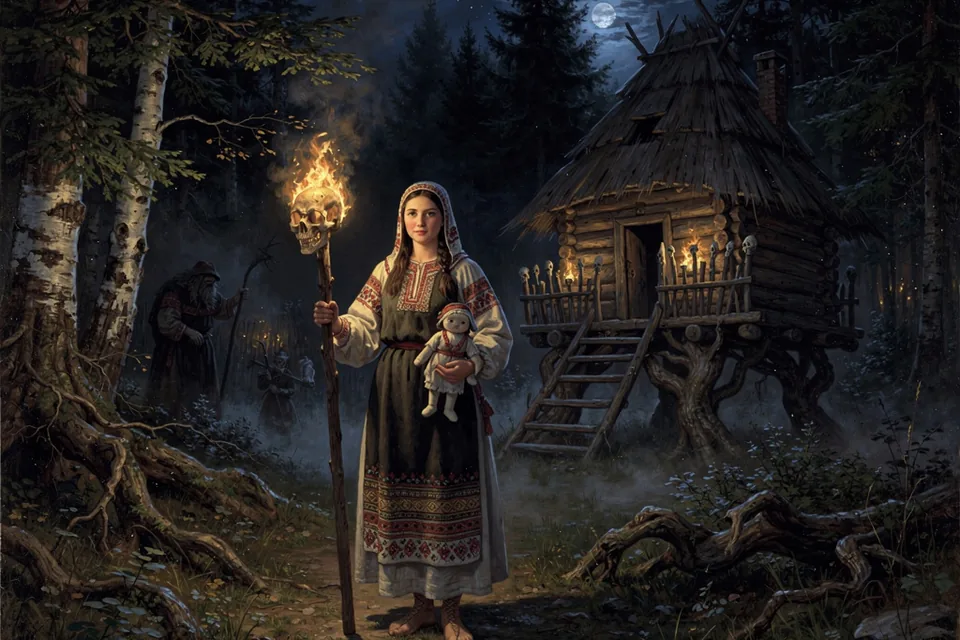
Before she dies, Vasilisa's mother gives her a small doll, telling her to feed it and confide in it whenever she is in need, and it will help her. Vasilisa's father remarries a woman with two daughters of her own, and the new stepmother, jealous of Vasilisa's beauty, sets her increasingly impossible household chores, hoping to see her fail or worse. On the night the family lets their fire go out, the stepmother sends Vasilisa into the forest to beg a light from Baba Yaga, expecting she will never return.
The witch's tasks
At Baba Yaga's hut, turning on chicken legs and fenced with a bone fence topped with skulls whose eyes light the yard, Vasilisa is set a string of impossible household tasks — separating clean grain from dirty, poppy seed from soil, cooking and cleaning for the witch — which her mother's doll secretly completes for her each night while she sleeps. Baba Yaga, unable to find fault or a reason to eat her, and unsettled by Vasilisa's refusal to ask about anything beyond what concerns her directly, finally sends her home with one of the glowing skulls from the fence as her fire.
The fire's judgment
Back home, the skull's eyes burn through the night, staring at the stepmother and her daughters until, by morning, they have burned to ashes, while Vasilisa is left untouched. She goes on, in the fuller telling of the tale, to weave cloth so fine it reaches the tsar himself, who marries her.