

The temple and its rites
Writing in Book 14 of his *Gesta Danorum* (c. 1200–1216), the Danish historian Saxo Grammaticus describes the temple of Svantevit at Arkona on Rügen in more physical and ritual detail than almost any other Slavic pagan site: a four-headed wooden idol holding a drinking horn and a sword, tended by a single priest forbidden even to breathe near the god's face without first exhaling outside the shrine.
The harvest horn
Once a year, after the harvest, the priest filled Svantevit's horn with wine and, the following day, examined how much liquid remained: if the horn had emptied, it foretold a poor year to come; if it was still mostly full, abundance was expected. The priest then poured out the old wine at the idol's feet and refilled the horn for the coming year, a rite the gathered community watched as a forecast for the whole territory.
The white horse and the crossed spears
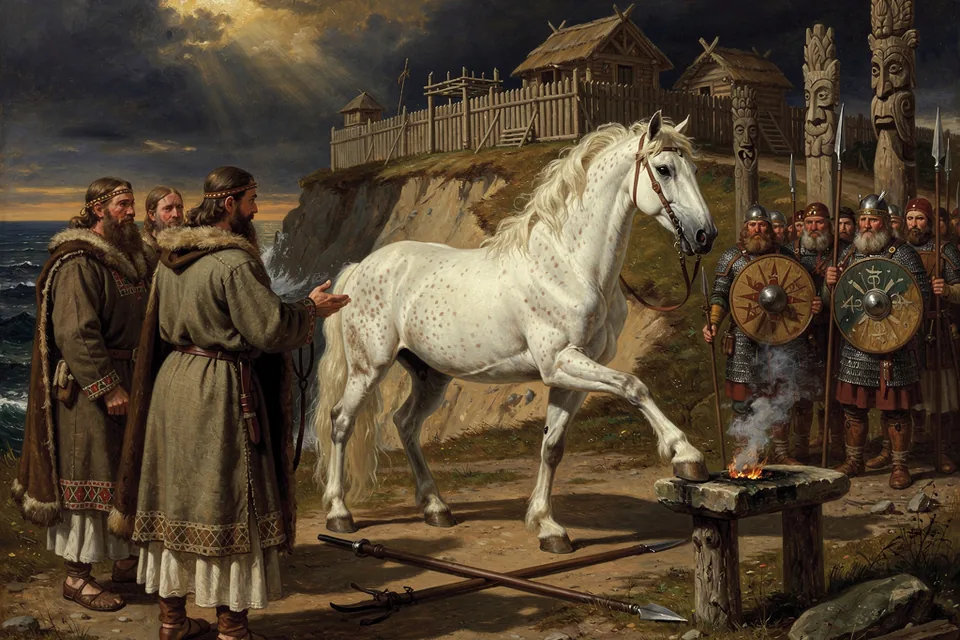
Saxo also describes a large white horse stabled at the temple, believed too holy for anyone but Svantevit himself to ride — priests claimed to find it sweated and muddied by morning, as though the god had ridden it fighting his enemies overnight. Before a military campaign, priests planted rows of spears in the ground, crossed in pairs, and led the horse over them: if it stepped over with its right foot first each time, the omen favored going to war; a stumble or a left-foot start called the campaign off. Saxo reports that the temple additionally received a tenth of all war-spoils taken by the Rani, kept in its treasury alongside tribute and ransom money, making Svantevit's cult also a center of very real material wealth and political power on Rügen.