

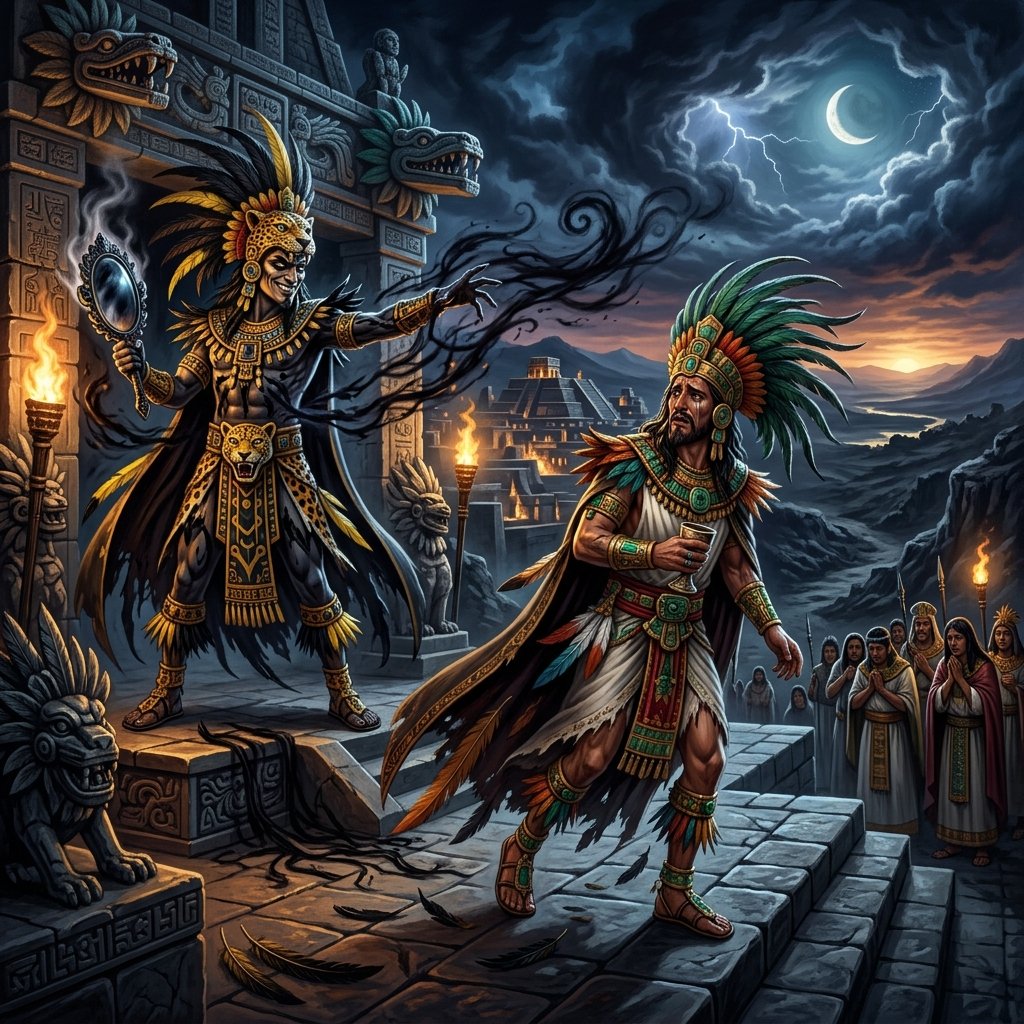
The Righteous King of Tollan
In the legendary city of **Tollan**, there ruled a priest-king named **Ce Acatl Topiltzin Quetzalcoatl**. He was the earthly embodiment of the Feathered Serpent, and under his rule Tollan became a paradise. The maize grew so large that men could barely carry a single ear. Cotton grew in every color. The Toltecs wanted for nothing.
Quetzalcoatl practiced strict penance and celibacy. He opposed human sacrifice, offering only jade, butterflies, and snakes to the gods. He was beloved by his people and despised by his rival **Tezcatlipoca**, the Smoking Mirror, who ruled through blood and chaos.
The Mirror and the Wine
Tezcatlipoca descended to Tollan in disguise, determined to destroy Quetzalcoatl. First, he appeared before the priest-king with a mirror wrapped in cloth. "My lord, I have come to show you your body," he said.
When Quetzalcoatl looked into the obsidian mirror, he saw himself as old and decrepit, his face covered with wrinkles and sores. He had never seen his own reflection before. He was horrified and hid himself away, believing he could no longer appear before his people.
Tezcatlipoca then sent sorcerers with **octli**, the fermented drink of the maguey plant. They convinced the distraught Quetzalcoatl to drink, claiming it would cure his distress. One cup led to another. Drunk for the first time in his life, the righteous king called for his sister **Quetzalpetlatl** and lay with her, breaking his sacred vows of celibacy.
The Morning After
When Quetzalcoatl awoke, he understood what he had done. His penance had been broken. His celibacy destroyed. The sorcerer Tezcatlipoca had defeated him without lifting a weapon. The priest-king wept and ordered his servants to prepare a stone casket.
He lay in the casket for four days as a symbolic death. Then he rose and traveled east toward the sea, accompanied by his followers. Along the way, he established rituals and named places. Everything he touched was marked by his passage.
The Departure
When Quetzalcoatl reached the shore of the divine sea, he dressed himself in his finest regalia: the feathered headdress, the turquoise mask, the jade ornaments. He set himself ablaze on a great pyre. His ashes rose into the sky, and his heart ascended to become the morning star, **Tlahuizcalpantecuhtli**.
Before his death, Quetzalcoatl made a prophecy: he would return in a **One Reed year** to reclaim his kingdom. When Cortes arrived in 1519, a One Reed year, the Aztec emperor Moctezuma feared the prophecy had come true. Some sources suggest this fear contributed to the Aztec hesitation that enabled the Spanish conquest, though modern scholars debate how much this tradition was shaped after the fact.