

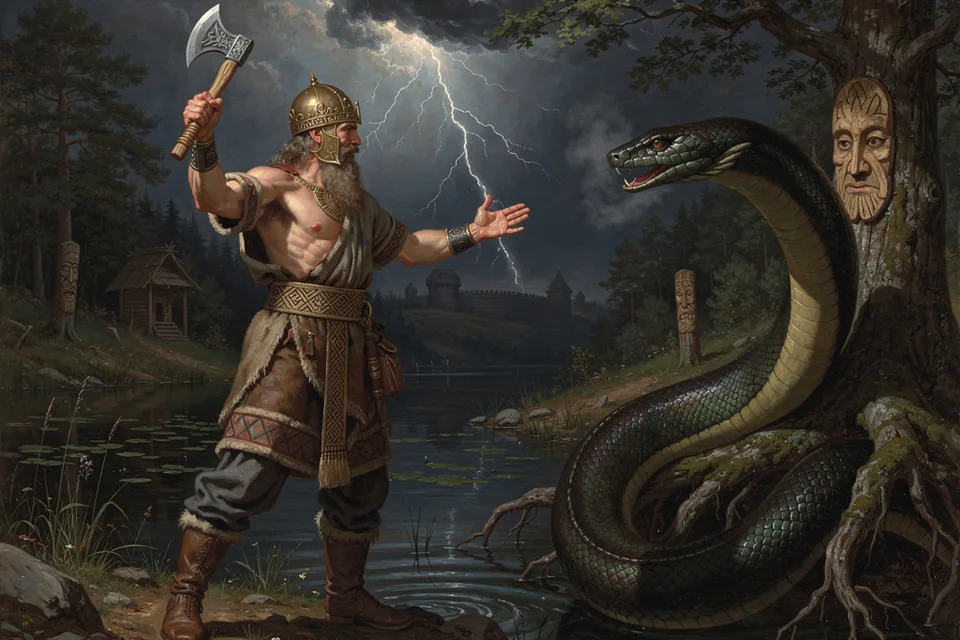
Flagged as reconstruction, not attested myth
No medieval Slavic text narrates a story of Perun fighting Veles. What follows is the widely cited 1974 reconstruction by the Soviet linguists Vyacheslav Ivanov and Vladimir Toporov, built from comparative method rather than from any single surviving narrative, and it is presented here explicitly as a modern scholarly hypothesis, clearly separated from the attested chronicle material about either god.
The method behind the reconstruction
Ivanov and Toporov worked outward from three kinds of evidence: East Slavic folk tales and proverbs (some collected by Afanasyev) in which a thunder figure chases a snake, wolf, or devil that hides under a tree, a rock, a person, or an animal; place names pairing hill-top or "Perun" sites with low-lying or "Volos/Veles" sites, including the separation between Perun's hilltop and Veles's low-ground placement in Kiev itself; and comparison with better-attested Indo-European storm-god-versus-serpent combats — Indra against the serpent Vritra in the Vedic *Rigveda*, and Thor's battles with the serpent Jörmungandr in Norse myth.
The reconstructed shape of the story
As reconstructed, a serpent-shaped Veles steals cattle, people, or water and hides in a low or hollow place (under a tree, a stone, or in the earth); Perun pursues him from the sky with lightning, splitting the tree or rock that shelters him; Veles flees through a series of transformations and hiding places until Perun's bolt finally strikes true, after which rain falls and order (or the stolen cattle/waters) is restored. Every element of that sequence is inferred, not quoted from a medieval source, and different scholars reconstruct the details differently — this retelling represents one influential version among several, not a settled text.