

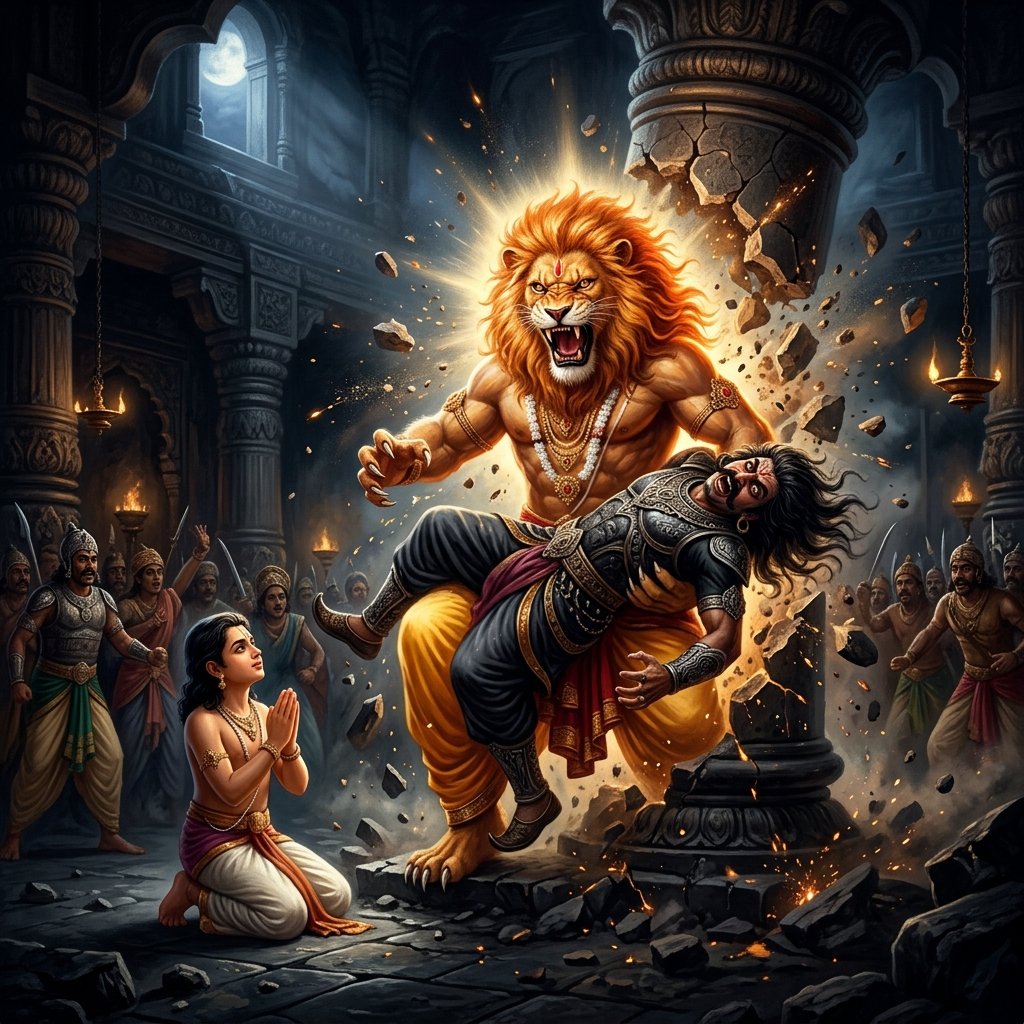
The Demon King's Boon
Hiranyakashipu was a powerful Asura king whose brother had been killed by Vishnu's boar avatar, Varaha. Consumed by hatred for Vishnu, he performed terrible austerities to win a boon from Brahma the Creator. After millennia of penance so severe that his body became a termite mound, Brahma appeared.
"Grant me immortality," demanded Hiranyakashipu.
"That I cannot give," replied Brahma, "for all things must die."
So Hiranyakashipu asked instead for conditions that would make death nearly impossible: he could not be killed by man or beast, by day or night, inside or outside, on earth or in sky, by any weapon. Brahma granted this boon, and Hiranyakashipu became a terror to the three worlds, even driving the gods from heaven.
The Devoted Son
But Hiranyakashipu's own son, Prahlada, was a devotee of Vishnu from the womb. While his father proclaimed himself the supreme being, Prahlada sang the praises of Vishnu. No punishment could shake his faith. His father cast him from cliffs, threw him into the sea, trampled him with elephants, exposed him to poison serpents, but each time Vishnu protected the boy.
"Where is this Vishnu you worship?" screamed Hiranyakashipu. "Is he in this pillar?" > "He is everywhere," replied Prahlada. "In the pillar and beyond it."
Raging, Hiranyakashipu struck the pillar with his fist.
The Man-Lion
The pillar exploded. From within emerged a being never seen before: Narasimha, half-man and half-lion, Vishnu's fourth avatar. He was neither man nor beast. The demon's boon was already failing.
Hiranyakashipu attacked with all his weapons and sorcery, but Narasimha was unstoppable. The man-lion seized the demon and carried him to the threshold of the palace—neither inside nor outside. He placed Hiranyakashipu across his lap—neither earth nor sky. The sun had just set—neither day nor night. And with his claws—not weapons—Narasimha tore open the demon's belly.
Every condition of the boon was satisfied, and yet Hiranyakashipu was slain.
The Wrath Cooled
But Narasimha's fury did not subside with the demon's death. The gods themselves trembled before this wrathful form. They sent Lakshmi, but even the goddess of fortune could not approach. Only Prahlada, the innocent boy whose devotion had summoned the avatar, walked forward without fear.
He touched Narasimha's feet and began to pray. Slowly, the terrible fire in the man-lion's eyes cooled. The growls softened. Narasimha blessed Prahlada, made him king in his father's place, and promised protection to all his descendants who remained devoted.
The Lesson of Devotion
Prahlada's story became one of Hinduism's greatest examples of bhakti, or devotional love. Against all worldly power—his father was king of the demons and conqueror of heaven—simple faith proved stronger. The universe itself would reshape to protect the devoted.
Narasimha's form demonstrated Vishnu's infinite creativity: when normal means cannot prevail, the Preserver finds a way. No boon can outwit the Supreme. No power can protect those who persecute the faithful. And no danger is too great for devotion to overcome.